
Niet gecategoriseerd
Captivated by sustainability together: the personal story of an enterprising duo
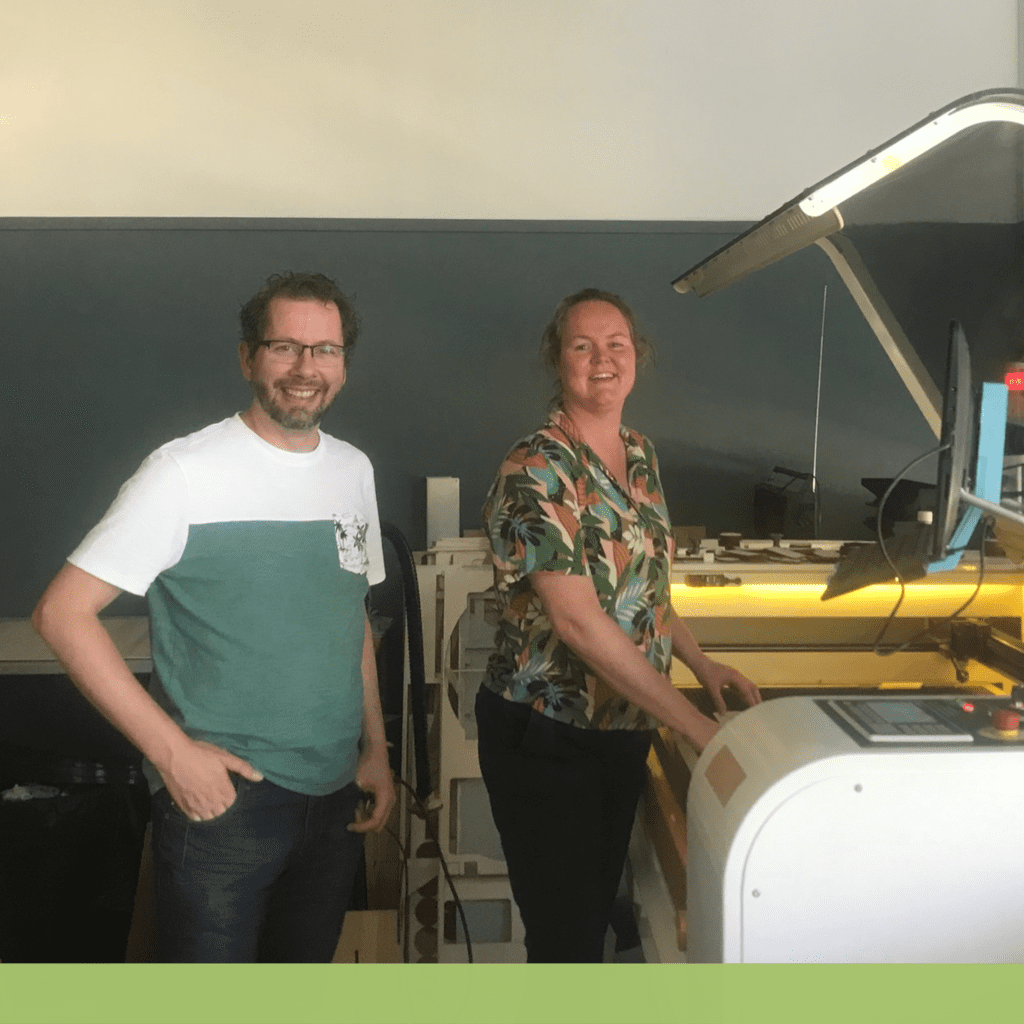
The personal story of Nienke & Paul and their shared passion
For years, Nienke and Paul have both been part-time sustainable entrepreneurs. Years ago, Nienke and Paul set out to build their eco-dream. Since then, they have been designing, making and selling special, personalised sustainable products made from ecological materials, to brighten up everyday life and life’s special moments. Eco-dreamer works with this enterprising couple to produce sustainable components of the Vestastik.
A fascination with the sustainable origins of materials and using materials efficiently
7 years ago, Nienke and Paul started their webshop Poetoeter, followed a few years later by Ecomaker, so they could combine their passion for design, their knowledge of materials and production methods, and sustainability. For Nienke and Paul, their commitment to sustainability goes without saying. Nienke grew up with it. “That awareness was there from an early age. Partly because we simply didn’t have much money to buy new things. We were brought up with the idea that we already had lots of stuff and that you could do all sorts of fun new things with it. That you could repair things, reuse them or find a new purpose for them. Still a really good attitude, I think. Nothing had to be ‘too fancy’ either. And we were also conscious of what was available locally. I was a ‘WWF kid’ too, who started her own little club with action plans and a donation jar we had to put 10 cents in every week,” Nienke smiles at the memory. As a child, Paul wasn’t much of an idealist when it came to the environment. For him, it’s an interest that has grown gradually over the past 25 years.
Besides the origins and types of ecological materials, Paul is fascinated by material efficiency. “I have a thing for material efficiency — or, put another way, I have a thing against physical waste,” says Paul with a twinkle in his eye. “Unfortunately, we do create it when we laser-cut our products.” In the early days, they also experimented with material-efficient design. “One of our first designs was a wreath made of circles, cut from several layers of wooden sheet. From the discs we cut out to make the circles, we cut more shapes to make wooden gift tags. And the shapes we cut out of those, we used as reusable table confetti — a kind of table decoration. That gave us 3 products and we could use almost the whole sheet. You end up with hardly any waste, but it did make the process a lot more complicated.” Nienke and Paul mostly make to order and keep hardly any stock. “Complicated, because we then had to sell all three products in the same proportions. When we lay out products on a sheet for cutting now, we obviously pay attention to material efficiency, but if you have small loose offcuts left over, it becomes time-consuming to make things one by one from those leftover pieces, because they also have to go on the laser cutter one by one. I do think it’s a shame that ‘time’ comes into play like that and can get in the way of reusing material. Still, it’s fun to keep puzzling over how you could make it work anyway,” Paul adds. “Definitely. I’ve been looking for a year now at how I can turn our wood waste into a new product. For example, by shredding it and making new sheet material from it. I’m making progress, but it hasn’t quite clicked yet.”
Nienke and Paul have a workshop at Plan-B in Eindhoven. It’s an old Philips building and nowadays a creative hub for lots of entrepreneurs, start-ups, artists and designers. Nienke is often impressed by the entrepreneurs around them. “They’re all small business owners who may not be widely known, but who really care about sustainability. They pay a lot of attention to reusing existing things, but also to what they buy and where they get things from. “Take Yatva Vintage, for example, a vintage clothing shop here in the building. During Dutch Design Week they once organised a fashion show here in the building, with nothing but vintage clothing. A few weeks beforehand they dropped by to ask if we had any objects they could use. Then they tipped out our wood waste bin and found all sorts of lovely little shapes, which they reused as accessories. Collaborations like this are just brilliant fun, and that kind of creativity is definitely inspiring.”
A sustainable lifestyle means making conscious, well-reasoned trade-offs between impact and what’s possible
Ask Paul how sustainable they are as consumers, and he answers with a smile and a fair question in return: “It depends — compared to what? We’ve had solar panels for three years now. We have an energy-efficient house, but it’s still on gas. An electric car is a big investment and isn’t that useful for us yet, because we don’t drive much. We’ve been flexitarians for 20 years. So we eat meat now and then, but certainly not 7 days a week. We regularly buy organic vegetables or cheese at the supermarket. Sometimes we have Picnic deliver our groceries instead of driving to the supermarket ourselves. You could debate whether that’s more energy-efficient or not — I don’t know. For our last two holidays we went by train, and not short distances either. We’re talking really serious distances, like to the south of France. That was a conscious choice to reduce our CO2 emissions. That’s how you discover that for 25 kg of CO2, the four of you can get to the south of France. By car we might have got as far as Brussels — or maybe not even that. So it definitely makes a difference compared with flying.”
Still, there are areas where Paul and Nienke would like to go a step further. “Eating meat is a bit of a thing for me; I notice we’re sort of stuck at twice a week. I find it hard to find alternatives because soya doesn’t agree with me,” says Nienke. “It’s also not always clear where the soya comes from, how far it has to travel, or how sustainably it’s been grown. I always find that the biggest problem in supermarkets. Really, they should state on every product how many kg of CO2 it took to make it. Say you have strawberries from the Netherlands and from Spain. If one says 10 kg and the other 5 kg, that makes the choice easier. It’s just that the legislation isn’t there yet to do that consistently, let alone that manufacturers know it themselves. I think it would really help a lot of people to weigh things up better. But there are also lots of people who simply can’t afford it, so when they can buy strawberries for once, they buy the cheapest ones, and that makes sense — I get that. But there are also plenty of people who really do want to make that choice.”
“For years I’ve made a point of buying mostly seasonal produce, and we now have a small vegetable garden at home, but I’d really love it if we managed to produce more of our own food. We’re now looking into whether we can join a Herenboeren community farm project. And we’ve found one nearby. Together with 200 households, you start a farm. You buy a piece of land and hire a farmer. On those 10 hectares, the farmer then grows the vegetables of the season, with a few chickens, pigs and cows so you can also get some meat from it, depending on what you need.” Nienke adds: “You could also help out on the farm. But if you can’t, it’s kept running anyway. Whereas if you have your own vegetable garden and, say, you can’t water it for 2 weeks in the summer, everything’s dead or has bolted.”
“Maybe the first question I should be asking customers is: ‘Do you really need this product?’ It sometimes feels contradictory — even when you make sustainable products, you’re essentially still promoting the idea that people keep buying things.”
Nienke Scholtes-van Eijk
Doing business sustainably remains a challenge, especially for small entrepreneurs
Paul and Nienke notice that many consumers stay focused on the (lowest) price. They feel there’s still not much interest in the story behind the product — for example, the choices you’ve made as an entrepreneur based on principles of quality and sustainability.
“Something else I find quite difficult is that the term ‘sustainable’ gets thrown around a lot, and that many people are easily convinced as long as it’s written in big letters and shouted about in advertising. Yet with a lot of things around you, you can really have your doubts. That’s why I find it hard myself to claim that my products are sustainable, because it’s simply hard to judge to what extent that’s true. Sustainable is a concept made up of many aspects. Is it about what material is used and where it comes from? How it breaks down? But also how long it lasts? Can you reuse it? How does it get here? And how far does it travel? How is it processed? How much energy does that take? So yes, if you want to do it properly, you have to factor lots of aspects into the picture to make the calculation,” Nienke explains. “Maybe the first question I should be asking customers is: ‘Do you really need this product?’” she says thoughtfully. “It sometimes feels contradictory — even when you make sustainable products, you’re essentially still promoting the idea that people keep buying things. And that’s not really the idea either, so I try to find a balance in that. That’s why we only want to focus on things that are special enough to keep for a long time.” Paul adds to what Nienke says: “That’s why I love our wooden flowers so much. Ordinary flowers take a lot of energy to grow and transport, and after a week they’ve wilted. They can go in the green bin for composting, so at least that’s good. Our wooden flowers might take just as much energy to make, but they last a very long time.”
Another challenge is the time you have to invest as an entrepreneur in sourcing the right materials. “In the beginning, when we were starting up, the idea of ‘sustainability’ was definitely on the rise, but what really disappointed me was how ‘hard’ it was to get hold of the right materials. What was available was actually very expensive, and therefore not profitable, or hard to come by. So if you want to make products and attach the label ‘sustainable’, ‘biobased’ or ‘biodegradable’ to them, you have to put a lot of time into finding the right materials. If you’re a large organisation with, say, a big purchasing department, it’s easier to make that investment.”
Generating enough visibility as a small sustainable business is also still a challenge. “You’re constantly up against big social media campaigns. If you’ve made a new sustainable product and want to promote it on Facebook or another channel, it quickly costs quite a lot of money, and you still get snowed under. Because you can show an ad 100 times, while a big player can simply show it to the whole of the Netherlands several times over through different channels. It sometimes feels like a chicken-and-egg dilemma. We first need more turnover to be able to spend more on marketing, but we also need marketing to generate more money,” Paul explains.
Helping each other even more through knowledge sharing & collaboration between small entrepreneurs
“What I’d like to pass on to other small sustainable entrepreneurs is this: if you know a group of entrepreneurs who are also doing well in their own way, seek them out a bit more often. Because I really like the idea of us small sustainable entrepreneurs seeking each other out and supporting each other more,” says Nienke. “We could inspire each other with the beautiful sustainable products that are already being made, but also share more knowledge and experience. For example, I’ve already come across lots of lovely sustainable materials, like a kind of leather made from plant and fruit waste. I experimented with it too and found out that in some applications it’s actually quite sticky. I’ve also come across materials that could have really great applications, but aren’t directly suitable for the sustainable products I make or for laser cutting them. That’s knowledge and experience I could share to help someone else along.”
We’re eco-dreamers. Are you?
More eco-dreams.
Read the other stories in our series, or tell us about your own eco-dream.